
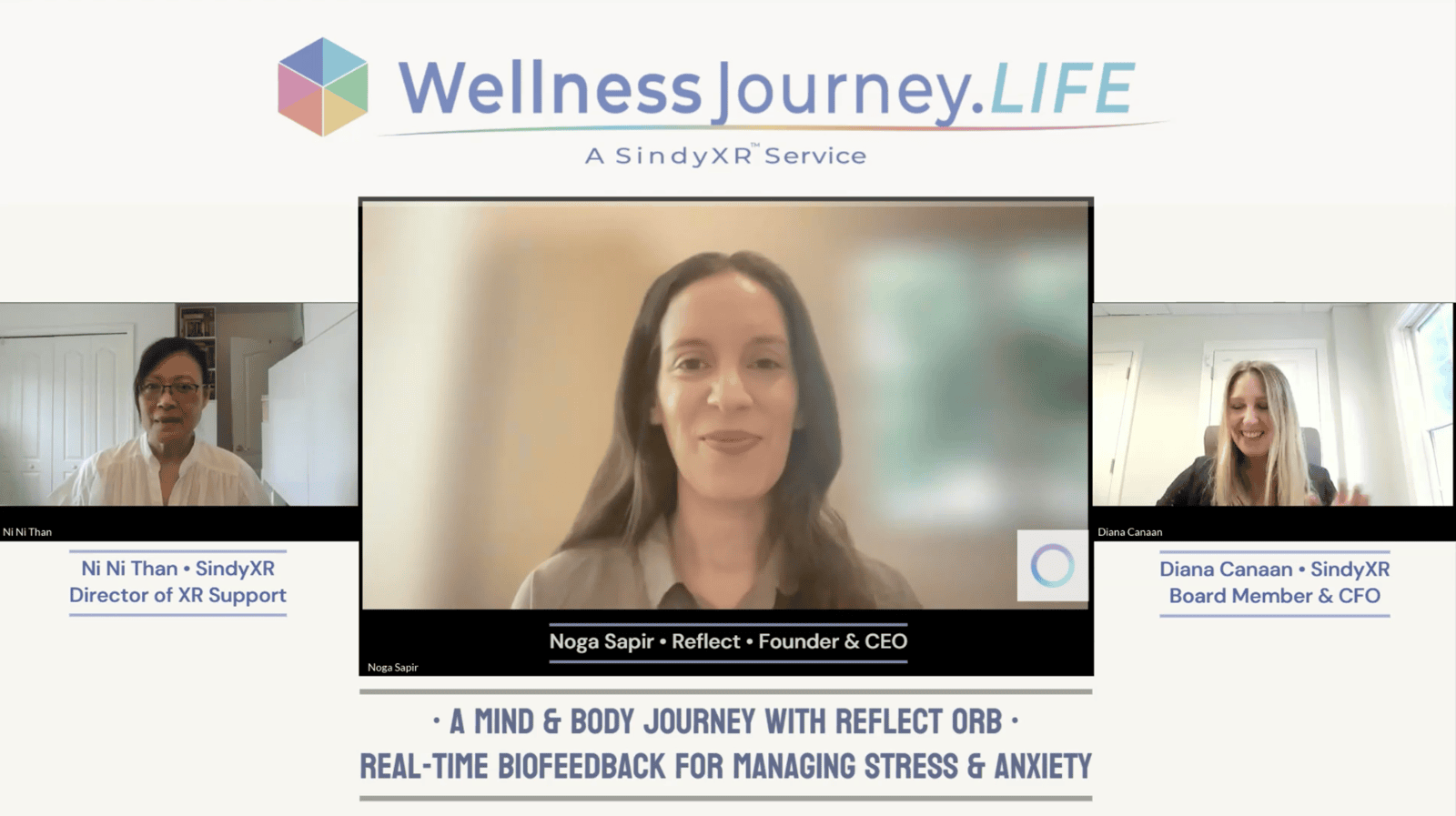
A conversation with Noga Sapir, Founder & CEO of Reflect, hosted by Diana Canaan, CFO & Board Member of SindyXR, and Ni Ni Than, Director of SindyXR Support
Published: WellnessJourney.LIFE
Guest: Noga Sapir, Founder & CEO, Reflect
Most of us carry our stress the same way: invisibly, until it isn't. We feel wound up, or wired, or exhausted, without any real way to see what our nervous system is doing in the moment or learn how to change it. Noga Sapir set out to solve that problem — not with another app competing for screen time, but with a soft, handheld object that responds to your body in real time. The result is the Reflect Orb, a biofeedback device that has found its way into homes, therapists' offices, and now the SindyXR community. In this episode of the WellnessJourney.LIFE interview series, Diana Canaan and SindyXR Support Director Ni Ni Than sit down with Noga to talk about the neuroscience behind the Orb, what it actually feels like to use, and why a device that "hugs you back" might be exactly what a screen-saturated world needs.
From a Racing Heart to a Neuroscience Degree
Noga's path to founding Reflect began with her own experience of anxiety — specifically, the disorienting fact that her heart could race to 170 beats per minute while she was sitting perfectly still during a panic attack. That gap between what her body was doing and what her mind understood led her to study neuroscience, hoping to make sense of the connection between thought and physiology. But it was a second, less obvious pivot — into textile design — that shaped the product itself. For her final academic project, Noga merged the two disciplines, building a tactile interface that could deliver biofeedback through something soft and comforting to hold, rather than the wires and clinical sensors typically associated with stress monitoring. Industrial designers told her plastic would be cheaper and easier to manufacture. She insisted on fabric anyway, because the entire premise of the Orb depended on it not feeling like a device that was "measuring" you.
"You can't force the color to change. You have to let go and be mindful. It isn't a magic pill — it's a window into your nervous system so you can learn to control it."
That design philosophy extends to how the Orb communicates. Rather than delivering a number or a stress score, it shifts color along a spectrum from purple — the most alert state — through blue and turquoise to white, the calmest state achievable. Noga deliberately avoids the word "stressed" in favor of "alert," since the body's physiological signature of excitement and the body's physiological signature of stress are often indistinguishable — purple could mean either. Underneath the color, the Orb is tracking two clinically established biofeedback markers: heart rate variability via ECG, which increases when the body is calm and flattens into a steady, soldier-like rhythm under fight-or-flight stress, and electrodermal activity (skin conductivity), a direct readout of sympathetic nervous system arousal. Over time, the device learns an individual user's baseline, turning a single session into part of a longer personalization process rather than a one-off reading.
A Training Field, Not a Quick Fix
Ni Ni Than's experience using the Orb over several weeks captures what makes the device different from a typical wellness gadget. A longtime meditator, she describes never quite knowing whether she was "getting there" during a session — until the Orb showed her, in real time, that what felt like calm on the surface wasn't always registering as calm physiologically. Used for roughly eight minutes each morning and again before bed, the practice has, in her account, measurably improved her sleep. The companion dashboard adds another layer: a calendar tracking session length and emotional state over time, along with insight into which techniques — breathing, sound, or visualization — work best for a given person. Reflect is also rolling out more granular personalization, including whether a given user's sessions are more effective at night or in the morning.
Noga frames the Orb explicitly as a "training field": a space to practice regulation techniques — specific breathing patterns, visualization — that a person can then carry with them even without the device in hand. That framing matters because it positions the Orb not as a dependency but as a rehearsal space for a skill the user is ultimately building in themselves. It is a subtle but important distinction in a wellness landscape often built around quick fixes rather than durable capability.
Where Screens Fail and a Soft Object Succeeds
Perhaps the most striking part of the conversation is what happens when the Orb reaches people beyond the individual, screen-fatigued adult it was originally designed for. In group settings, Noga describes a kind of physiological synchronization that emerges among participants — a shared regulation that a screen-based app has no real analog for. With children, the response is even more direct: rather than intellectualizing the color changes the way adults tend to, kids simply immerse themselves in the experience. That makes the Orb a particularly effective tool for children with ADHD or difficulty with emotional regulation, giving them a language of color to describe internal states they may not yet have words for — and it's part of why therapists have begun recommending it directly to patients.
One advisor's description of the device has stuck with the team: you hug it, and it hugs you back. That tactile, physical relationship to a piece of wellness technology — in a category otherwise dominated by screens, notifications, and dashboards — is exactly the kind of tool SindyXR is glad to bring into its own wellness circles. Regulation of the nervous system is not usually something we're taught to see, let alone train. Making it visible, and making it feel like comfort rather than clinical measurement, is what the Reflect Orb is quietly good at.
Watch the Full Interview
Watch now on YouTube:youtube.com/@SindyXRWellnessJourney
Subscribe to WellnessJourney.LIFE: youtube.com/@SindyXRWellnessJourney
Explore all six branches of wellness at WellnessJourney.LIFE