
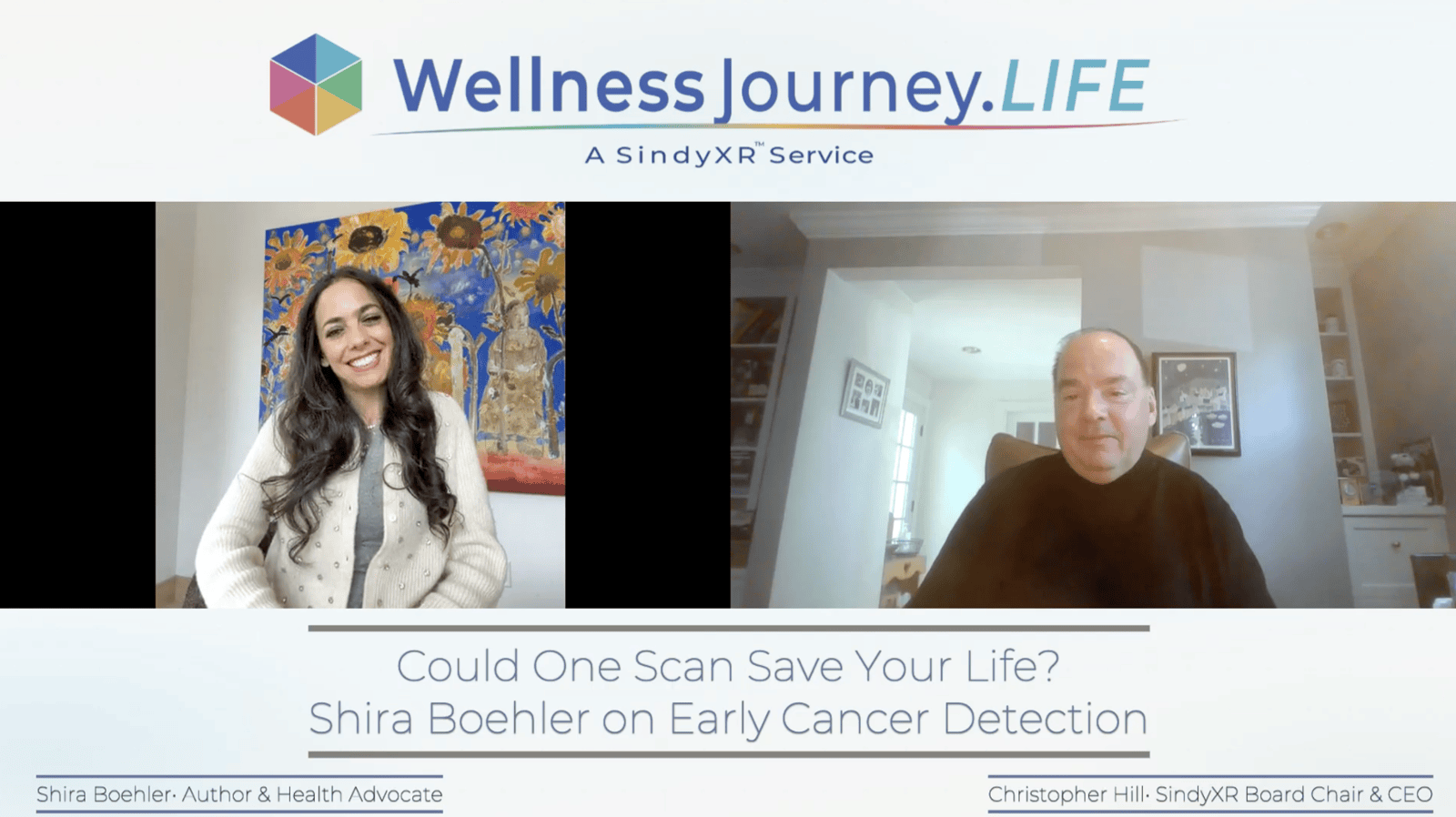
A conversation with Shira Boehler, Lung Cancer Survivor, Health Advocate & New York Times Bestselling Author of "One Scan Saved My Life," hosted by Christopher Hill, Chairman & CEO of SindyXR
Published: WellnessJourney.LIFE
Guest: Shira Boehler, Author, "One Scan Saved My Life: How One Woman's Story Would Change the Way We Detect Lung Cancer"
Website:cancerdoesntcare.com
Lung cancer kills more women every year than breast, ovarian, and cervical cancers combined — and almost no one knows it. Shira Boehler didn't either, until she was lying in a hospital bed with half her right lung removed. A New Orleans native, mother of four, lifelong runner, and never-smoker with no symptoms and no risk factors on paper, Shira's diagnosis defied every assumption the medical system makes about who gets lung cancer and why. In this episode of the WellnessJourney.LIFE interview series, Shira sits down with SindyXR Chairman and CEO Christopher Hill to talk about the scan that saved her life, the guidelines that would have let her cancer go undetected for years, and why she believes the single biggest shift American medicine needs to make is from sick care to healthcare.
A Diagnosis That Broke
Every Rule Shira's story is, on its face, almost implausible. Her father is a lung specialist. Her mother is a pediatrician. Both of her brothers are doctors. She never touched a cigarette in her life, ate carefully, and ran six miles a morning, six days a week. She and her husband run a healthcare investment firm and have spent over a decade signing up early for every emerging diagnostic — 23andMe, the Galleri Grail blood test, full genome sequencing, and eventually a full-body MRI she resisted for years because of severe claustrophobia. It was that MRI, one she canceled twice and only completed because her husband rescheduled it a third time, that flagged a 3.8 cm mass in her lung — noted as minor, not worth worrying about in the absence of symptoms. A follow-up low-dose CT a few months later found the mass had grown to 4.2 cm. It, too, came back with instructions not to worry unless symptoms appeared. Days later, a third scan and a bronchoscopy confirmed it: stage 1B adenocarcinoma, an aggressive lung cancer, in a 43-year-old woman with an exceptional pulmonary function test and no reason, by any conventional guideline, to have been screened at all.
"You don't actually have symptoms from lung cancer until it's too late. You can't feel your lungs the way you can feel breast tissue — and by the time you do have a symptom, it's often already spread to your bones or your brain."
That gap between diagnosis and symptom is, in Shira's telling, the entire story of why lung cancer is so lethal. Current Medicare, Medicaid, and commercial insurance guidelines only cover low-dose CT screening for patients over 50 who have smoked a pack a day for 20 years — a standard built around a decades-old picture of who gets lung cancer that no longer reflects the data. Studies out of Asia, later replicated in New York City, have found that never-smoking women are developing lung cancer at higher rates than their smoking male counterparts, for reasons researchers still can't fully explain. Breast cancer survivors, Shira learned in her own research, carry double the risk of developing lung cancer as a primary cancer within five years of their diagnosis. None of that is captured by a guideline built for a "Marlboro Man" archetype that increasingly doesn't match reality.
Healthcare, Not Sick Care
The distinction Shira returns to again and again is the one she believes is at the root of the problem: a medical system oriented around treating illness rather than preventing it. Catch lung cancer at stage one, when it can be surgically removed, and the five-year survival rate is over 90 percent. Catch it at stage four — which is how it's found in the vast majority of cases, because there are simply no earlier warning signs — and survival drops below 10 percent. The math, Shira points out, isn't just a matter of life and death; it's a matter of economics. When insurance companies ran their own backdated claims analysis at her request, the finding was unambiguous: early detection saves both lives and money. Her own treatment — CT, bronchoscopy, surgeon consult, PET scan, and surgery, completed within a single week — ran a fraction of the cost of the chemotherapy, radiation, and immunotherapy regimens that stage four patients often require for years.
Christopher Hill draws a parallel to his own experience getting a full-body MRI purely out of caution, and the mixed reaction he got from his own primary care doctor — proud, but wary of a broader shift toward patient-driven testing. That tension, between a medical establishment built around gatekeeping and a growing population of patients demanding proactive answers, runs through the entire conversation. Shira's response is not to abandon doctors but to arm patients to advocate within the system: her website, cancerincare.com, offers a printable one-page explainer patients can bring to their own physicians to request a low-dose CT — a two-minute scan that costs roughly $200 out of pocket when insurance won't cover it, and that Shira now considers as routine as a mammogram or a colonoscopy.
The Loneliness of a Cancer With No Community
Perhaps the most quietly devastating part of Shira's story isn't medical at all — it's social. When her mother was diagnosed with breast cancer, friends rallied immediately, offering meals and support. When Shira told people she had lung cancer, the first question was almost always some version of "I didn't realize you smoked." The assumption of fault — that lung cancer patients somehow brought it on themselves — creates a stigma that breast cancer, colon cancer, and most other cancers simply don't carry, and it leaves survivors like Shira isolated at the exact moment they need community most. Even among fellow patients, she found other lung cancer survivors reluctant to speak openly about their diagnosis, ashamed of a disease they did nothing to cause.
That isolation is precisely why Shira's advocacy work — and conversations like this one — matter beyond the individual medical facts. Recovery from a diagnosis like hers is not only physical; her own surgeon told her that a third of his thoracic surgery patients experience serious depression afterward, and Shira was proactive about starting therapy and medication the day after her surgery. Community, shared experience, and simply being believed when you say you did nothing wrong to deserve a diagnosis are their own form of medicine — the same human infrastructure that platforms like SindyXR exist to provide alongside clinical care, not in place of it. Shira's advice to anyone standing where she once stood is simple and direct: advocate for yourself, ask for the scan, and don't wait for a symptom that may never come in time.
Watch the Full Interview
Watch now on YouTube: youtube.com/@SindyXRWellnessJourney
Subscribe to WellnessJourney.LIFE: youtube.com/@SindyXRWellnessJourney
Explore all six branches of wellness at WellnessJourney.LIFE