
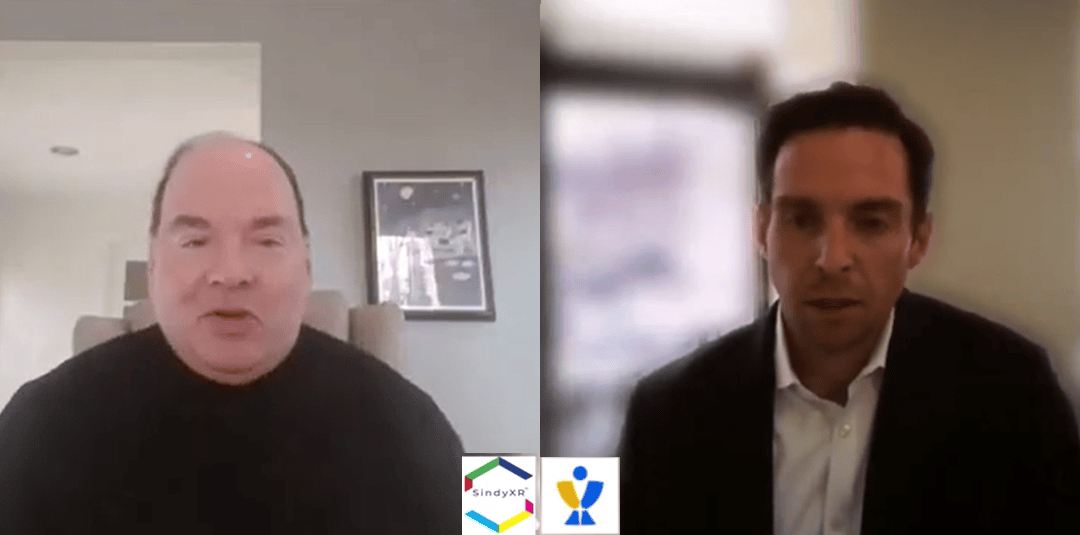
The Future of Patient-Centric Healthcare: AI, Innovation, and Affordability with Jordan Harmon

27.06.26 04:47 PM

A conversation with Jordan Harmon, SVP & Chief Innovation and Products Officer, Catholic Health

Published: WellnessJourney.LIFE

Guest: Jordan Harmon, SVP & Chief Innovation Officer — Catholic Health

Watch: https://www.youtube.com/@SindyXRWellnessJourney

Few people in American healthcare have had a better vantage point on the intersection of clinical innovation, institutional strategy, and patient experience than Jordan Harmon. As a strategic leader at organizations including the Hospital for Special Surgery (HSS) in New York — one of the world's premier orthopedic institutions — and in his current role as Senior Vice President and Chief Innovation and Products Officer at Catholic Health, Harmon has spent his career translating emerging technology into real-world improvements in care quality, access, and cost. In this episode of the WellnessJourney.LIFE interview series, he sits down with host Christopher Hill to offer a sophisticated, grounded perspective on where AI and patient engagement are headed — and what it will actually take to get there.


Two Buckets: Administrative AI and Clinical AI


Harmon opened by drawing an important distinction that often gets lost in healthcare AI conversations: the difference between AI applied to administrative functions and AI applied to clinical decision-making. The first bucket — revenue cycle management, credentialing, prior authorizations — is where much of today's AI investment is concentrated, and for good reason. These administrative burdens consume enormous physician time and contribute significantly to clinician burnout. Tools that automate note-taking are already showing remarkable results: Harmon described a patient who noted that, for the first time, their doctor was looking at them during the appointment rather than at a screen. That shift — from a physician divided between patient and keyboard to one fully present in the clinical encounter — has measurable implications for patient trust, compliance, and outcomes.


"Because of an AI note-taking tool, it was the first time a patient had actually seen their doctor's face. People are more likely to take recommendations from someone looking them in the eye."


The second bucket — clinical decision support and quality improvement — is where Harmon is most energized, and where he sees the greatest unrealized potential. He described work at HSS on robotic surgery analytics: connecting the technical data captured by surgical systems with patient-reported outcome measures to help surgeons learn from thousands of cases simultaneously, identifying patterns that no individual practitioner could accumulate in a career. He also pointed to AI-assisted imaging at HSS-founded company Imagin, which achieved accuracy in fracture detection that rivaled or exceeded experienced radiologists. The challenge, he noted, is not building these tools — it is validating them rigorously enough for real-world clinical deployment and establishing clear value propositions for health systems navigating tight margins.


Affordability, Pharmacogenetics, and the Precision Medicine Frontier


When the conversation turned to healthcare affordability — one of the defining challenges of American medicine — Harmon offered a characteristically practical perspective. Affordability, he argued, is not a single problem with a single solution. It requires addressing out-of-pocket costs, co-insurance structures, drug pricing, and the fundamental question of what an individual patient can actually afford and access. Price transparency regulations, which forced hospitals to publish their pricing in machine-readable formats, represent the kind of policy lever that no institution would have moved on voluntarily — but which created genuine market-level pressure. Harmon is cautiously optimistic that a combination of regulatory change, consumer pressure, and market competition is beginning to move the needle.

He reserved particular enthusiasm for pharmacogenetics — the science of matching medications to an individual's genetic profile to predict how they will metabolize a given drug. For decades, medicine has functioned on a trial-and-error model: try a drug, observe the response, adjust. Pharmacogenetics promises to collapse that process, enabling physicians to prescribe the right medication at the right dose from the first appointment. The cost implications are significant: fewer failed medication trials means fewer adverse events, fewer additional appointments, and faster resolution of the underlying condition. Combined with AI-driven analysis of wearable data and personalized health profiles, Harmon sees precision medicine evolving from a specialized offering into a standard of care within the decade.

The Patient's Role in Driving Change


One of the most democratizing arguments Harmon made in this conversation is that the transformation of healthcare does not have to wait for institutions or governments to lead. Patients — individually and collectively — have market power that is still largely untapped. He described the retail healthcare environment, where organizations like CityMD must compete on patient experience metrics like wait times, cleanliness, and staff communication because consumers have choices. That competitive dynamic, he argued, is slowly spreading into more traditional healthcare settings. Concierge medicine — where patients pay out of pocket for extended, personalized access to a physician — is one expression of this shift. The opportunity, as Harmon sees it, is to bring the quality of that experience to a broader population through technology, scale, and smart platform design.
For the WellnessJourney.LIFE community, the message from this conversation is both validating and motivating. The healthcare system is changing — not as fast as any of us would like, but in the right direction. AI is freeing physicians to be more present. Data is enabling more personalized treatment. Platforms built for patient engagement are beginning to fill the spaces between clinical appointments that have historically been left empty. And patients who show up informed, curious, and willing to advocate for their own care are already changing the dynamics of every appointment they attend. That is the future Jordan Harmon is working toward — and it is a future every WellnessJourney.LIFE member is helping to build.


Watch the Full Interview 

Watch now on YouTube: https://youtu.be/3FCvb1HDYeQ

Subscribe to WellnessJourney.LIFE: youtube.com/@SindyXRWellnessJourney
Explore all six branches of wellness at WellnessJourney.LIFE

Share -