
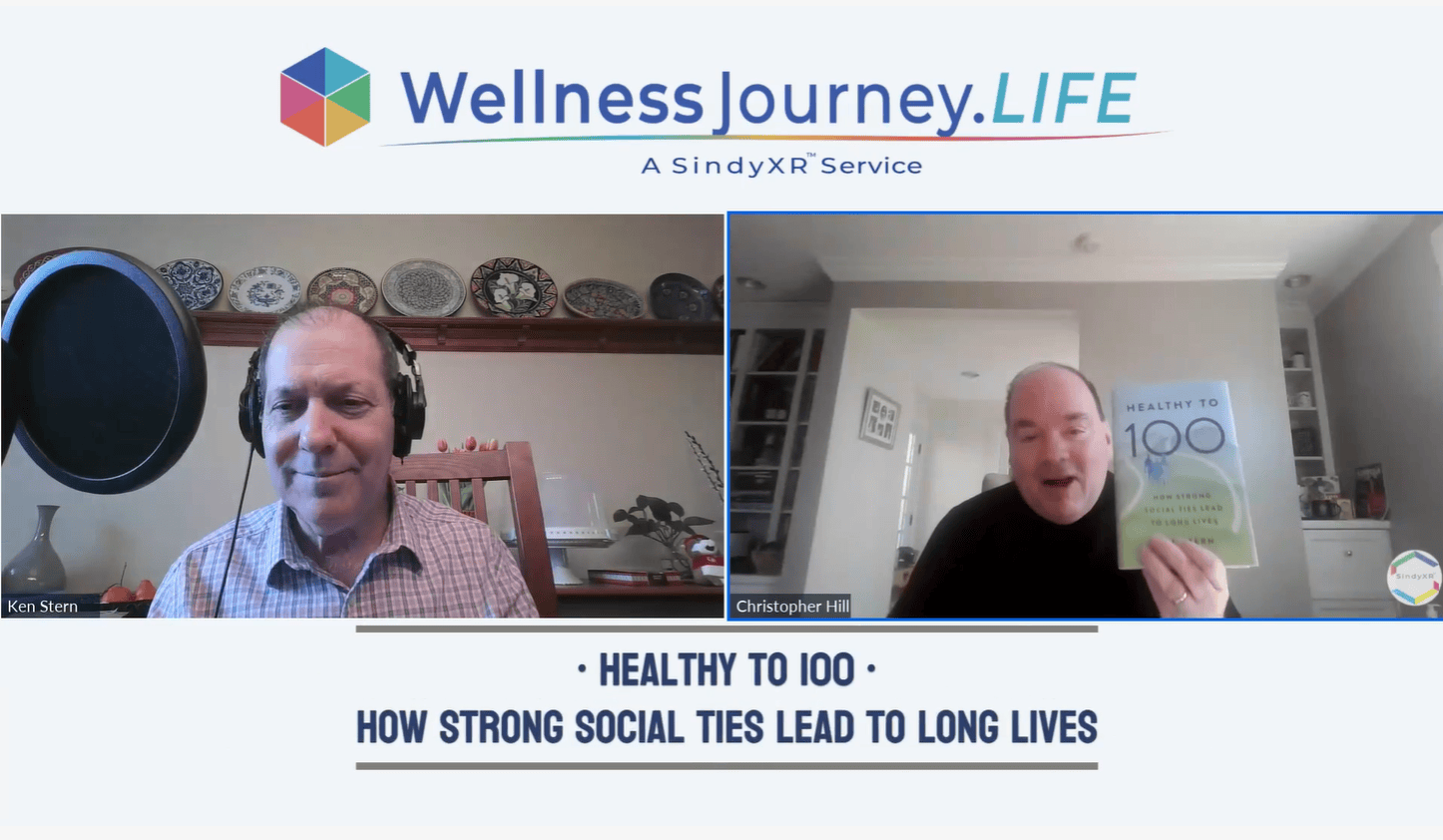
A conversation with Ken Stern, Founder of the Longevity Project and Author of Healthy to 100
Published: WellnessJourney.LIFE
Guest: Ken Stern, Founder —The Longevity Project · Author, Healthy to 100
We have been told for decades that the path to a long, healthy life runs through the gym, the salad bowl, and the doctor's office. What science has learned over the last twenty years is that we have been leaving out the most important ingredient of all. Ken Stern — former CEO of National Public Radio, founder of the Longevity Project, and author of Healthy to 100: How Strong Social Ties Lead to Long Lives — has spent years synthesizing the global research on what actually drives longevity. His conclusion, supported by the longest-running study of human development in American history, is both simple and radical: the quality of your relationships matters more to your lifespan than your diet, your fitness routine, or your access to healthcare. In this episode of the WellnessJourney.LIFE interview series, he makes the case for social health as the missing pillar of modern medicine.
The Loneliness Epidemic — and Why Social Media Made It Worse
The paradox at the center of Stern's work is one that anyone who has ever felt alone in a crowded digital world will recognize immediately. We live in the most 'connected' society in human history, by every quantitative measure: more platforms, more messages, more followers, more engagement metrics than any previous generation could have imagined. And yet the number of Americans reporting that they have no close friends has skyrocketed. Young adults today spend an average of an hour less per day in face-to-face social interaction than the generation before them. The institutions that once anchored community life — religious organizations, unions, civic associations, neighborhood groups — have been in long-term decline for decades. We are communicating more with devices and less with people, and the health consequences of that shift are only now being fully reckoned with.
"Being lonely is roughly equivalent to smoking 15 cigarettes a day. Conversely, being socially connected and having purpose is correlated with longer life expectancy, lower cancer risk, and better cognitive health."
The research Stern cites is unambiguous. The Harvard Study of Adult Development — the longest longitudinal study of human development in American history, now approaching nine decades — began following 200 Harvard undergraduates and 200 young men from disadvantaged Boston neighborhoods in the 1930s. Its conclusion, in the words of current director Robert Waldinger, is straightforward: happiness and life success come down to the quality of the relationship with the person next to you. Not wealth. Not healthcare access. Not genetics. The social bond. And the absence of that bond — loneliness — exerts a physiological toll on the body that is now measurable and documented: elevated inflammation, suppressed immune function, accelerated cognitive decline, and a mortality risk roughly comparable to smoking a pack of cigarettes a day.
What Long-Lived Societies Do Differently
Stern traveled extensively to study the communities and countries where people consistently live the longest and healthiest lives, and his findings carry a consistent theme. In Japan, where the median life expectancy for women has reached 90, older adults are encouraged to remain in part-time work for social engagement; the Silver Human Resources Agency represents a million workers aged 65 to 106, eighty percent of whom work for social reasons rather than financial ones. In South Korea, lifelong learning is a constitutional right, with 'lifelong learning cities' built so that no citizen is more than a ten-minute walk from a classroom. In Italy, even in Bergamo — ground zero of the COVID pandemic's early devastation — the response to isolation-related suffering among the elderly was not to further separate the generations, but to replace senior-only centers with all-age centers where intergenerational relationships could be maintained.
The American model, by contrast, has systematically dismantled the architecture of intergenerational community. The 20th century created the cultural expectation of leaving home at 18, followed by retirement communities that separate older adults entirely from the generations that give their presence meaning and context. Stern argues that this is not just culturally impoverished — it is biologically anti-evolutionary. Human beings have lived in multigenerational communities for the entirety of our species' history. The isolation of age cohorts from one another is a recent and, the evidence suggests, deeply unhealthy experiment. Generations, he observes, fit together like puzzle pieces: their connection is good for the health of the old and the development of the young simultaneously.
Social Health as Public Health — and a Personal Practice
The most actionable dimension of Stern's argument is also the simplest: social connection is a health behavior, in the same category as exercise, nutrition, and sleep — and it should be treated with the same intentionality. This means not just maintaining existing relationships but actively building and protecting the conditions for connection: volunteering, joining communities of shared interest, pursuing lifelong learning, engaging in meaningful work at every life stage. For those navigating health challenges, it means seeking out and participating in communities of people with shared experience — exactly the kind of communities that platforms like SindyXR are designed to create and sustain. The evidence is clear that these communities do not merely make people feel better. They measurably improve clinical outcomes, reduce healthcare utilization, and extend life.
Ken Stern's own journey adds a personal dimension to his research that is worth sitting with. He did not find his real passion — writing and storytelling — until he was 50 years old, after careers as a lawyer and a media executive. In previous centuries, 50 would have been near the end of a human lifespan. Today, it can be the beginning of a next act that is richer, more purposeful, and more connected than anything that came before. That is the promise of longevity when it is built on the right foundation — not just more years in a life, but more life in the years. It is a promise that every member of the WellnessJourney.LIFE community is working toward, one relationship at a time.
Watch the Full Interview
Watch now on YouTube: https://youtu.be/XkiHCu1wVAc?si=O06mj940uf4_gb6b
Explore all six branches of wellness at WellnessJourney.LIFE