
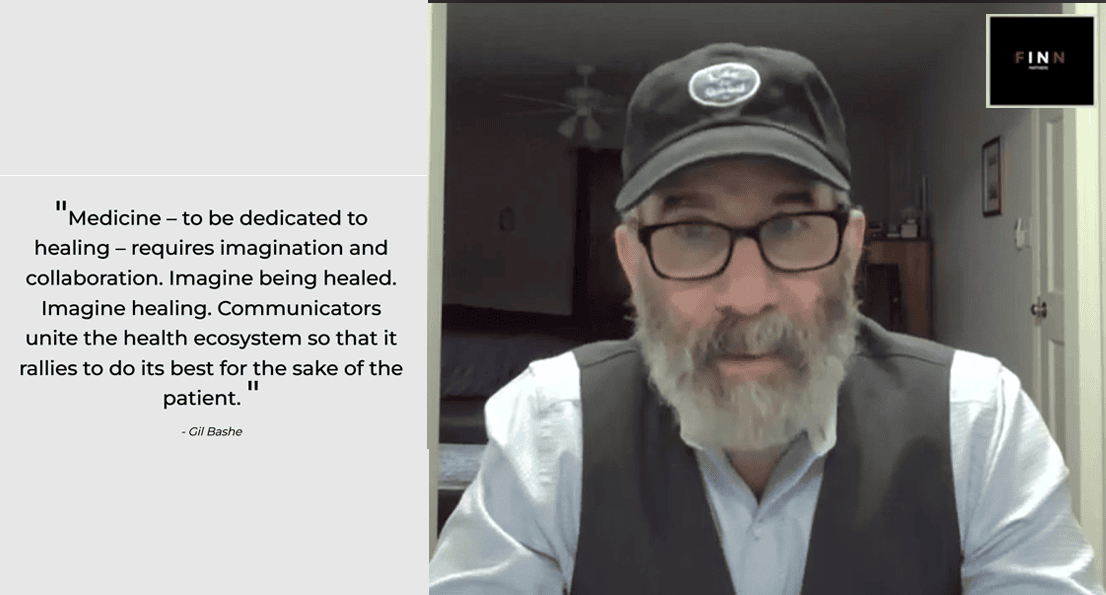
A conversation with Gil Bashe, Managing Partner & Chair of Global Health and Purpose, Finn Partners
Guest: Gil Bashe, Managing Partner & Chair of Global Health — Finn Partners
The United States spends $4 trillion on health every year — more than twice the per capita expenditure of any other developed nation — and yet ranks among the shortest-lived populations in the economically advanced world. That paradox sits at the heart of this urgent and candid conversation between WellnessJourney.LIFE host Christopher Hill and Gil Bashe, one of the most respected voices in global health communications. As managing partner and chair of global health and purpose at Finn Partners, Bashe has spent decades at the intersection of healthcare policy, patient advocacy, and industry strategy, giving him a rare vantage point on what is working, what is failing, and what it will actually take to build a system worthy of the people it is supposed to serve.
A Sick-Care System in a Healthcare World
Bashe opens with a diagnosis that is both obvious and consistently ignored: the United States does not have a healthcare system. It has a sick-care system. The distinction matters enormously. American medicine excels at treating people who are already ill — the surgical expertise, the pharmaceutical innovation, the intensive care capabilities are genuinely world-class. But the system has almost no architecture for keeping healthy people healthy. The investment in prevention, early intervention, lifestyle medicine, and community health infrastructure is a tiny fraction of the total spend. The result is a nation that is simultaneously the most medically sophisticated and among the least healthy of its peer nations, with chronic disease rates that continue to climb despite trillions of dollars in annual expenditure.
"We've got to bring our humanity back into the process. Payers don't call people 'customers' — they call them 'beneficiaries.' That tells you everything about where the patient sits in the system."
The fragmentation of the system, Bashe argues, is its deepest structural flaw. Not a shortage of brilliant clinicians, not a lack of pharmaceutical innovation, and not simply the high cost of drugs — which represent only 11 percent of total health spending. The problem is a healthcare ecosystem so fragmented that the left hand genuinely does not know what the right hand is doing: insurers and providers operating at cross-purposes, patients navigating byzantine billing systems, and a culture of medicine that has historically treated the patient as a passive recipient of expert decisions rather than the most informed and motivated stakeholder in their own health outcome.
The Patient Voice: The Most Underused Resource in American Medicine
The most powerful argument Bashe makes — and the one with the most direct relevance for the WellnessJourney.LIFE community — is about the patient voice. He is emphatic: patients have the most skin in the game of any participant in the healthcare system, and yet medical culture has systematically undervalued, dismissed, and occasionally actively silenced that voice. The stethoscope, he says with characteristic precision, should not close off a physician's hearing. Medical schools, in his view, should require a dedicated course on the patient experience — not as a soft skill elective, but as a core clinical competency, on the same level as pharmacology or anatomy.
AI, Bashe argues, has the potential to be one of the most powerful tools for patient empowerment in the history of medicine — not by replacing physicians, but by giving patients the informational parity they need to participate meaningfully in clinical conversations. A patient who arrives at an appointment having used AI to understand their diagnosis, research their treatment options, and formulate specific questions is not a difficult patient. They are the kind of patient that drives better outcomes for everyone in the room. The culture of medicine that treats informed patients as a threat to clinical authority is, in Bashe's view, one of the system's most self-defeating tendencies — and one that AI-enabled patient education has the potential to gradually erode.
Community as the Catalyst for Change
One of the most optimistic threads in this otherwise clear-eyed conversation is Bashe's conviction that community — people with shared health experiences connecting with and supporting each other — is both a proven driver of better outcomes and a natural, organic response to the failures of the formal healthcare system. Disease, he observes, is a trans-demographic connector: it brings together people across every division of income, geography, and background in a way that few other human experiences can match. Platforms like SindyXR, which create structured, physician-supervised communities for patients with similar conditions, represent exactly the kind of infrastructure that can convert that organic human impulse into a measurable health intervention.
The path from sick care to genuine healthcare, in Bashe's telling, runs directly through the patient. Not through insurance reform alone, not through drug pricing legislation alone, and not through technology alone — though all of these matter. It runs through the recognition that the person sitting across from the physician is not a beneficiary. They are a customer, a collaborator, and ultimately the most important person in the room. When medicine learns to listen to that person with the same rigor it applies to a clinical trial, the transformation of American healthcare becomes not just possible but inevitable.
Watch the Full Interview
Watch now on YouTube: https://youtu.be/ahMpA4BYFJU
Explore all six branches of wellness at WellnessJourney.LIFE