
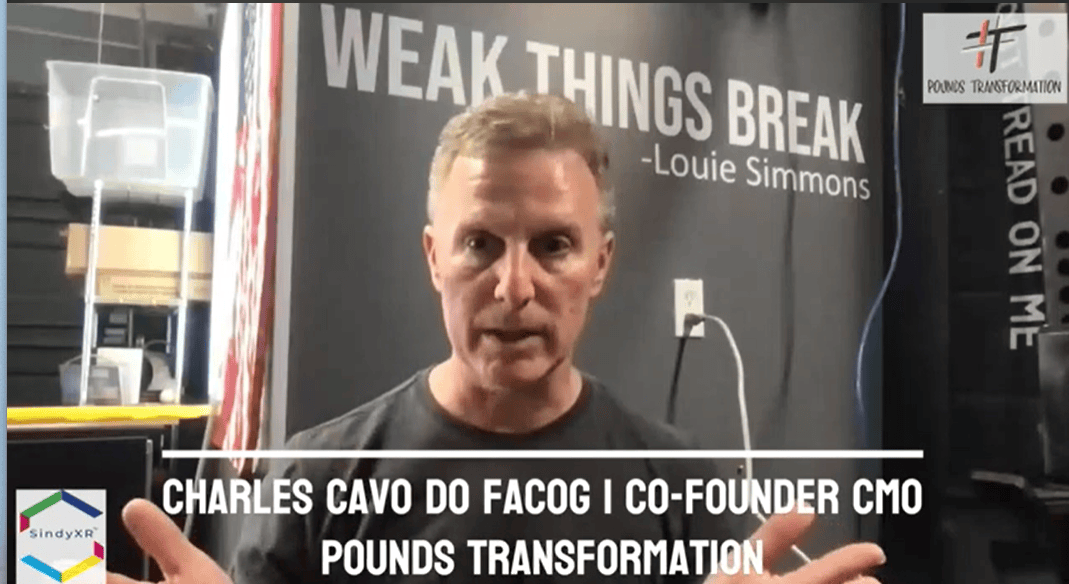
A conversation with Dr. Charles Cavo, Co-Founder & Chief Medical Officer, Pounds Transformation
Published: WellnessJourney.LIFE
Guests: Dr. Charles Cavo, CMO — Pounds Transformation · Board Advisor — SindyXR
For most of the history of medicine, the window a physician had into a patient's daily health was vanishingly small — a few minutes in an exam room, every few months, informed by whatever the patient could recall about how they had been feeling. That window is now open around the clock. In this episode of the WellnessJourney.LIFE interview series, Dr. Charles Cavo — co-founder and Chief Medical Officer of Pounds Transformation and a board advisor to SindyXR — describes what it looks like when a clinical practice fully embraces the convergence of AI, wearable technology, and remote patient monitoring. The picture he paints is not a distant future. It is the standard of care he is delivering today, in Connecticut, to patients managing obesity, diabetes, metabolic syndrome, and a spectrum of chronic conditions that conventional medicine has long treated as lifelong sentences.
From Gut Feelings to Real-Time Data
The evolution Dr. Cavo describes in his practice is a microcosm of the broader shift happening across medicine. When Pounds Transformation began, the clinical model was the same one practiced everywhere: see patients in person, take a history, form a relationship, and adjust treatment based on self-reported progress at the next appointment — weeks or months later. COVID shattered that model by forcing the entire practice into telehealth overnight. What emerged was not just a new delivery channel, but a new philosophy: continuous engagement rather than episodic care. The pandemic forced clinicians and patients alike to realize that the space between appointments was not a gap to be tolerated. It was the most important terrain in chronic disease management.
"AI is forming a partnership and bridging the doctor-patient relationship — physicians can speak up here while patients need the information down here, and AI bridges that gap."
Into that space came wearable technology, and Dr. Cavo is direct about its transformative impact. Continuous glucose monitors — small sensors worn on the back of the arm that track blood sugar in real time, 24 hours a day — have changed the patient-food relationship more effectively than any dietary counseling tool he has encountered. When a patient can see, in the moment, that a food they considered harmless caused a significant metabolic spike, the behavioral modification that follows is immediate and self-reinforcing. Breath-based ketone analyzers give patients in ketogenic protocols an objective, instant feedback loop on whether their dietary choices are actually producing the fat-burning state they are targeting. These devices do not just collect data — they create accountability in a way that transforms patient motivation.
AI as the Analytical Engine Behind Better Care
The wearable data, however, is only as valuable as the analytical layer built on top of it. This is where AI enters Dr. Cavo's practice with particular force. Body composition data — which breaks down a patient's weight into lean mass, fat mass, water, and muscle — when fed into AI alongside laboratory markers like HbA1c, insulin levels, and inflammatory markers like CRP, enables a quality of individualized treatment planning that was simply not achievable before. Rather than giving patients generic advice to 'eat less and move more,' the practice can now generate precise macronutrient targets calibrated to each patient's actual metabolic reality, adjust them in near real-time based on incoming wearable data, and track the clinical impact over weeks and months.
AI-assisted meal planning takes this personalization further still. Dr. Cavo describes working with platforms that use AI to generate full weekly meal plans based on a patient's specific conditions, food preferences, and nutritional targets — drawing on millions of recipes and combining palatability with clinical precision in a way that no human nutritionist could maintain across a large patient population. SindyXR's AI layer adds another dimension: by analyzing the language, themes, and patterns emerging from group health support sessions, it enables physicians to understand their patient population's most pressing concerns and evolving needs at a scale that individual one-to-one appointments could never reveal.
Remote Patient Monitoring: The End of the Four-Week Wait
Perhaps the most clinically significant innovation Dr. Cavo describes is Remote Patient Monitoring (RPM) — a system in which patients use cellular-equipped devices at home (scales, blood pressure cuffs, glucose monitors) that transmit their readings directly into the clinical medical record in real time. The implications are profound: instead of waiting four to six weeks between appointments to discover that a patient's blood pressure has been climbing or their weight has stalled, the clinical team can see that data daily, send targeted messages, adjust treatment plans, and intervene before a small problem becomes a significant one. The reactive, appointment-driven model of chronic disease management is giving way to something genuinely continuous — a persistent, low-friction clinical relationship that more closely mirrors the reality of how chronic conditions actually behave in daily life.
For the WellnessJourney.LIFE community, the message from this conversation is both practical and empowering. The technologies Dr. Cavo describes — CGMs, ketone analyzers, AI-assisted nutrition, remote monitoring — are not experimental. They are available now, increasingly covered by insurance for qualifying conditions, and already demonstrating meaningful improvements in patient outcomes. If you are managing a chronic condition, or are concerned about metabolic health, diabetes risk, or cardiovascular wellness, this is the conversation that shows you what the frontier of care actually looks like when a clinical team is willing to use every tool available. The future of chronic disease management is not quarterly appointments. It is daily data, continuous learning, and a care team that is truly with you between visits.
Watch the Full Interview
Watch now on YouTube: https://youtu.be/J8-e_kqTijs
Subscribe to WellnessJourney.LIFE: youtube.com/@SindyXRWellnessJourney
Explore all six branches of wellness at WellnessJourney.LIFE